







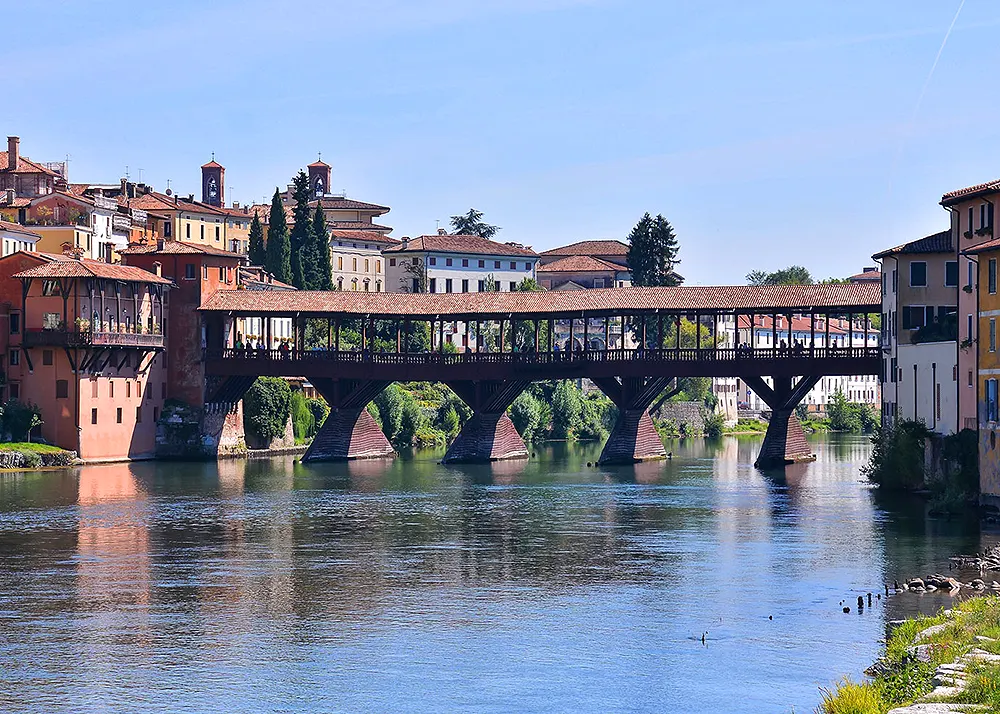
Old Bridge
Bassano del grappa
The bridge over the Brenta river is considered one of the most characteristic bridges in Italy. Known as the "Ponte Vecchio", "Ponte di Bassano" or "Ponte degli Alpini" is a covered wooden bridge. Over the years there have been numerous interventions and reconstructions, the last restoration being in 2021. The first document attesting its existence dates back to 1209. A vigorous flood of the Brenta, in October 1567, overwhelmed the existing bridge. The architect Andrea Palladio was called for the reconstruction who initially designed a stone bridge, completely different from the previous one, with three arches on the model of the ancient Roman bridges. The city council did not like the project, which required the architect not to deviate too much from the traditional structure. In the summer of 1569, Palladio therefore presented a second project: a wooden bridge similar to the previous structure, but with completely renewed technical and structural solutions, and of great visual impact. In 1748 an overwhelming flood of the river overwhelmed it and it was Bartolomeo Ferracina's task to reconstruct it in a manner faithful to the Palladian design. Set on fire in 1813 by Viceroy Eugene of Beauharnais, it was rebuilt in the same form in 1821 by Angelo Casarotti. Since 1928, the bridge has been the symbol of the Alpini. Dedicated to the memory of the hundreds of thousands of Alpine troops who crossed the bridge during the First World War to climb the Sette Comuni plateau, a place of battle for over 41 months. Flattened for the third time by a bombing on February 17, 1945, it was rebuilt, according to the original Palladian design, by the Giulio Tessarolo & Figli di Rosà company. Following damage caused by the exceptional flood with flood of 1966, a systematic structural restoration was carried out which was followed by various extraordinary interventions, not least the stability control works of the structure and of the immersed parts completed in May 2021. In June 2019 it was declared a National Monument